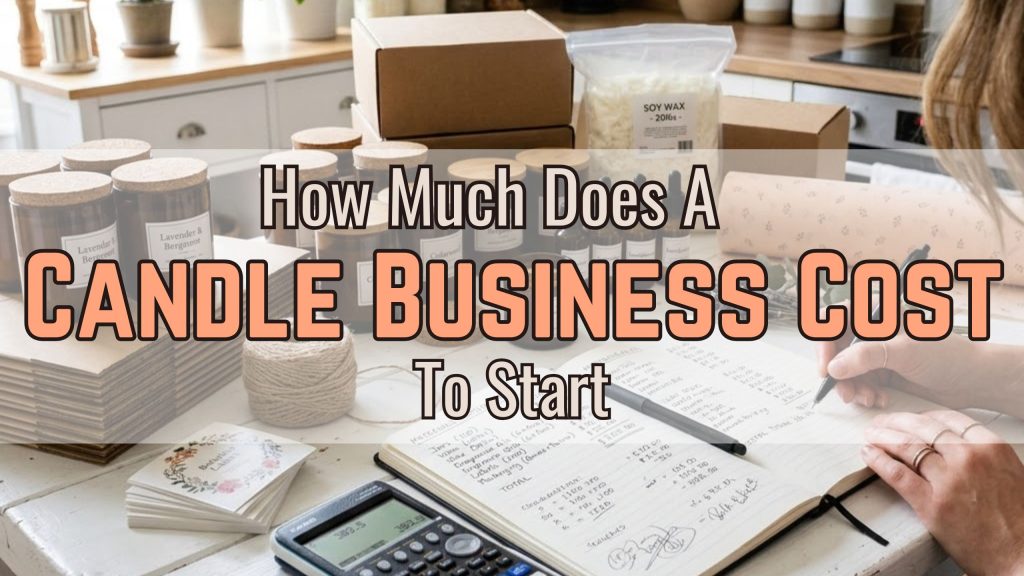
If you’ve been wondering how much does it cost to start a candle business from home — the honest answer is: probably a lot less than you think.
This is genuinely one of the most affordable businesses you can start from home. You don’t need a commercial kitchen, a warehouse, or a huge investment upfront. Thousands of people have built a real successful candle business starting with just a couple hundred dollars, a kitchen table, and a whole lot of passion. The key is knowing exactly what you need, what you don’t, and where your money is actually going — so you spend smart right from the beginning.
We’ve broken everything down into three simple budget levels — starter, mid-range, and serious — so you can see exactly where you fit right now and where you’re headed as you grow. Let’s get into it.
Affiliate Disclosure: This article contains affiliate links which means we may earn a commission at no extra cost to you. You can check our affiliate disclosure page here.
The Three Levels of Starting a Candle Business
Before we get into specific numbers, it helps to understand that there’s no one-size-fits-all answer to starting a candle business. Your costs depend on how many candles you plan to make, how you plan to sell them, and how polished you want your brand to look from day one
Here’s the big picture:
- Starter level — just testing the waters, making small batches: $100–$300
- Mid-range — ready to sell, building a proper setup: $300–$700
- Serious launch — building a real brand from the start: $700–$1,500+
Most people who are serious about a beginner candle business land somewhere between the starter and mid-range levels to begin with. Now let’s look at what actually goes into those numbers.
1. Wax — Your Biggest Supply Cost
Wax is going to be your biggest ongoing expense, so it’s worth understanding it well from the start.
The most popular waxes for a homemade candle business are:
- Soy wax — clean burning, great for container candles, easy to work with. Costs around $2–$4 per pound.
- Coconut wax — premium, beautiful finish, higher price point. Around $4–$6 per pound.
- Paraffin wax — very affordable, strong scent throw, less popular with eco-conscious buyers. Around $1–$2 per pound.
- Beeswax — natural and premium, but expensive. Around $8–$12 per pound.
For a beginner, a 10-pound bag of soy wax is a great starting point. That’s enough to make around 15–20 medium candles depending on jar size.
Budget estimate: $20–$60 for your first batch
2. Fragrance Oils or Essential Oils — The Scent
This is where your candles get their personality. Fragrance oils are the most popular choice for candle making — they’re affordable, consistent, and come in hundreds of scents. Essential oils are more natural but require a higher fragrance load and cost more per ounce.
A good rule of thumb: you’ll use about 1 oz of fragrance oil per pound of wax (at a 6% fragrance load). A 4 oz bottle of fragrance oil costs around $5–$12 depending on the supplier and the scent.
Start with 3–5 scents you love and that suit your brand. You can always expand later.
Budget estimate: $20–$60 for 3–5 fragrances
3. Containers and Jars — What Holds It All
Your jar is part of your product — it’s the first thing a customer sees, and it says a lot about your brand. Candle business supplies for containers include:
- Basic clear glass jars — around $1–$2 each when bought in packs of 12
- Amber Jars — $2–$4 each
- Tins — $0.75–$2 each, great for markets and gifting
- Ceramic or concrete vessels — $4–$10+ each, great for premium positioning
For your first order, buying a case of 12–24 matching jars keeps things simple and consistent.
Budget estimate: $20–$50 for your first batch of jars
4. Wicks — Small Cost, Big Impact
Wicks are inexpensive but choosing the right one matters a lot for how your candle burns. The wick size needs to match your jar diameter and wax type — wrong wick = tunnelling, poor throw, or a flame that’s too big.
Cotton wicks are the most popular. They come in packs of 50–100 for around $5–$12. Always buy a few different sizes so you can test which works best in your specific jar.
Budget estimate: $10–$20 for an assortment pack
5. Tools and Equipment — The One-Time Investments
This is where the candle business equipment costs come in — and the good news is, most of these are one-time purchases that last for years.Here’s what you actually need:
- Digital scale — for measuring wax and fragrance precisely. $10–$25.
- Pouring pitcher — stainless steel, holds melted wax for pouring. $10–$20.
- Double boiler or wax melter — to melt your wax safely. A basic pot setup costs nothing if you have one; an electric wax melter runs $20–$60.
- Thermometer — to know exactly when to add your fragrance and pour. $10–$15.
- Wick centring bars — keeps wicks centred while wax sets. $5–$10 for a pack.
- Stir sticks or silicone spatulas — $5–$10.
- Heat gun (optional but useful) — for fixing sinkholes and smoothing tops. $15–$30.
Budget estimate: $75–$160 for a full equipment set
6. Packaging and Labels — What Makes It Sellable
If you’re planning to sell candles, packaging is not optional — it’s part of your product. This is where your candle goes from homemade to professional.
- Labels — you can design your own on Canva and print at home or through a print shop. A sheet of 30 home-printed labels costs almost nothing. Professional printed labels run $0.10–$0.50 per label depending on quantity.
- Warning labels — required for candle safety. These are small and inexpensive, often sold in packs of 100 for $5–$10.
- Boxes, tissue paper, ribbon — depends on how premium your packaging is. Budget $0.50–$2 per candle for basic gifting presentation.
Budget estimate: $20–$80 depending on how polished you want to start
7. Business Setup Costs — The Admin Side
This is the part most candle business for beginners guides skip — but it matters.
- Etsy shop — free to open, $0.20 per listing, 6.5% transaction fee on sales
- Your own website — Shopify starts at around $29/month; Squarespace from $16/month
- Business registration — varies by location, often $20–$100 for a sole trader or LLC
- Candle liability insurance — highly recommended if you’re selling. Around $200–$500/year depending on your country and coverage
You don’t need all of this on day one — but knowing these costs exist helps you plan properly. Many people start with Etsy and move to their own website once they’re generating consistent sales.
Budget estimate: $0–$200 to get started, depending on your setup
8. Your First Test Batch — The Hidden Cost Everyone Forgets
Here’s something no one talks about enough in any candle making business plan: your first few batches are test batches. You will remake candles. You will try different wicks. You will adjust your fragrance load. This is completely normal and completely necessary — it’s how you build a product worth selling.
Budget for at least 2–3 test batches before you start selling. It’s not wasted money — it’s the cost of getting your product right.
Budget estimate: Add 20–30% to your supply costs for testing
Full Budget Breakdown at a Glance
| Cost Item | Micro Starter ($150–$300) | Solid Beginner ($300–$600) | Ready to Launch ($600–$1,000) |
|---|---|---|---|
| Equipment (scale, pitcher, thermometer, etc.) | $93–$150 | $150–$200 | $200–$225 |
| Wax (first order) | $20–$25 | $25–$35 | $35–$40 |
| Fragrance Oils (3–5 scents) | $30–$40 | $40–$50 | $50–$60 |
| Wicks | $10 | $15 | $20 |
| Jars / Containers | $30–$40 | $40–$55 | $55–$70 |
| Labels & Packaging | $15–$20 | $20–$30 | $30–$40 |
| Shipping Supplies | $0 (local only) | $20–$30 | $30–$40 |
| Branding & Logo | $0 (DIY Canva) | $0–$25 | $25–$50 |
| Business Registration | $0 | $0–$50 | $50–$200 |
| Insurance | $0 | $0 | $0–$200 |
| Estimated Total | $150–$300 | $300–$600 | $600–$1,000 |
Can You Start Even Smaller?
Yes — absolutely. If your budget is tight, here’s how to start for under $100:
- Buy a small 5 lb bag of soy wax (~$12)
- Get 2 fragrance oils you love (~$16)
- Order a 12-pack of basic glass jars (~$14)
- Buy a wick assortment pack (~$8)
- Use pots you already own for melting
- Print labels at home on sticker paper
- Sell to friends and family first, or do a small local market
This gets you making and selling candles for real — with almost nothing upfront. Then you reinvest your first profits into growing your setup. That’s the candle business guide approach that actually works for most people who go on to build something real.
What to Buy First vs. What Can Wait
Buy from day one:
Wax, wicks, fragrance oils, jars, a scale, a thermometer, a pouring pitcher, warning labels
Can wait until you’re making sales:
A label printer, premium packaging, a wax melter, a heat gun, your own website, bulk orders
Don’t buy yet:
Commercial equipment, large inventory, expensive branding packages, paid ads
Recommended Supplies to Get You Started
Getting your first order right makes a real difference to how quickly you can start making and selling. Here are the candle business essentials worth having from day one — and what to look for when buying each one.
For your wax, look for a pure soy wax designed specifically for container candles — not pillar or paraffin blends. The packaging should state the recommended fragrance load percentage. This matters for how strong your candles smell when they burn.
For fragrance oils, buy from a supplier that lists flash points and skin-safe percentages. This tells you the oil is made for candle use, not just for diffusers. Start with crowd-pleasing scents — clean cotton, vanilla, lavender, or a warm woody scent — before experimenting.
For wicks, don’t guess. Most wick suppliers have sizing guides based on your jar diameter. Buy a sample pack of a few different sizes and do burn tests before committing to a large order. A poorly wicked candle tunnels or drowns — and that means returns.
For jars, straight-sided glass jars are the easiest to work with for beginners — they fill evenly, wick correctly, and look clean and professional. Amber glass has become very popular and photographs beautifully.
For your scale, look for one that measures in 0.1 gram increments and has a tare function. That one detail — being able to zero out the scale with your pitcher on it — saves so much time during production.
For your pouring pitcher, stainless steel with a stay-cool handle and a proper spout. Aluminium conducts heat too fast and can cause wax to cool unevenly before you finish pouring.
For labels, start with printable kraft or white labels at home to keep costs low. Once you find a design that works and sales are coming in, invest in professionally printed labels — the difference in how your product is perceived is remarkable.
Everything listed above is searchable on Amazon, Etsy supply shops, or specialist candle suppliers like CandleScience, Brambleberry, or The Flaming Candle. Buying from a specialist candle supplier often works out cheaper per unit than Amazon once you’re ordering regularly — and the quality is more consisten
The candle makers who build successful candle businesses aren’t the ones who spent the most at the beginning. They’re the ones who started with what they had, learned their craft properly, tested their products thoroughly, and reinvested their profits as they grew. They treated every batch as a lesson, every sale as proof that it was working, and every dollar reinvested as a step toward something bigger. That’s the real candle business start up strategy — not a big budget, but a smart one. Start where you are, spend on what matters, skip what doesn’t, and build from there. Your candle business is closer than you think.
Related Articles: