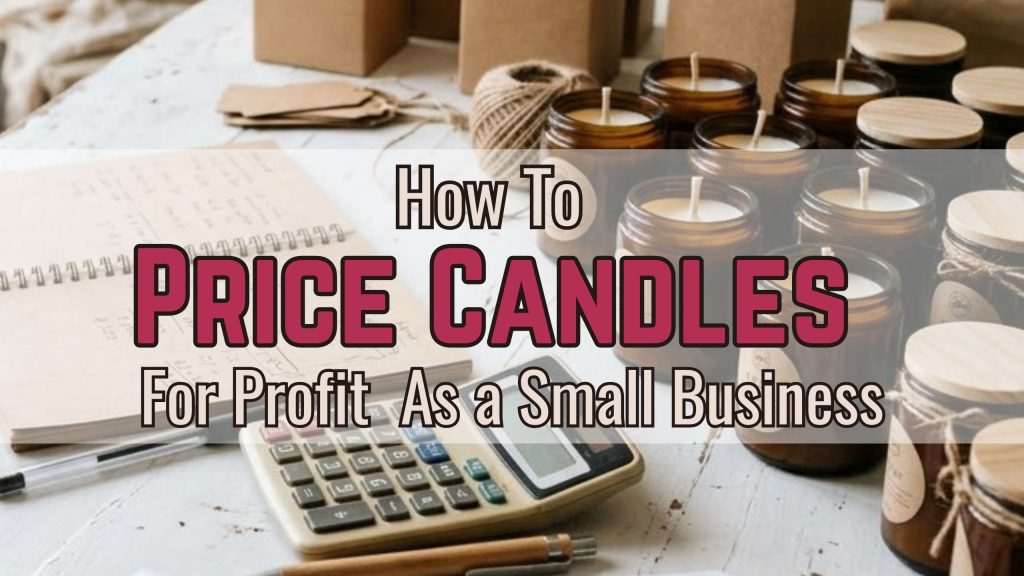
So many people who start a small candle business make the same mistake — they price their candles too low because they’re scared no one will buy them. But here’s the truth: if you price your candles too cheap, you end up working really hard and barely making anything. That’s not a business, that’s just a very tiring hobby! You deserve to get paid fairly for your time, your supplies, and all the love you pour into every single candle you make.
The good news? There’s a simple candle pricing formula that makes figuring out your prices so much easier. You don’t need to be a math genius or take a business class. You just need to know your numbers, follow a few easy steps, and have the confidence to charge what your candles are actually worth. Thousands of candle makers are running a profitable business from their kitchen table — and with the right pricing, you absolutely can too.
Affiliate Disclosure: This article contains affiliate links which means we may earn a commission at no extra cost to you. You can check our affiliate disclosure page here.
How To Price Candles For Small Business
Let’s break it all down, step by step.
Step 1: Add Up Your Material Costs
The very first step in how to price handmade candles is knowing exactly how much it costs you to make one candle. These are called your material costs — also known as the cost of goods.
For each candle, add up:
- Wax — how much did you use per candle?
- Fragrance oil — measure carefully, this adds up fast
- Wick — even a small cost counts
- Container or jar — this is usually one of the bigger costs
- Labels and packaging — stickers, boxes, tissue paper, ribbon
- Lid, box, or any extras
Let’s say all of that comes to $4.50 per candle. That’s your material cost. Write it down!
Step 2: Add Your Labour (Your Time Matters!)
This is the part most beginners skip — and it’s a big mistake. Your time has value. You are not a robot. You are a skilled maker who deserves to be paid.
Decide on an hourly rate for yourself. Even $10–$15 an hour to start is fair. Then figure out how long it takes you to make one candle — including melting, pouring, labeling, and packaging.
If it takes you 20 minutes per candle and you pay yourself $12/hour, that’s $4 in labour per candle.
So now you have:
- Materials: $4.50
- Labour: $4.00
- Total cost so far: $8.50
Step 3: Add Overhead Costs
Overhead costs are the little things that don’t go directly into the candle but still cost you money. Things like:
- Electricity for your wax melter
- Shipping supplies
- Your website or Etsy fees
- Candle making tools that wear out over time
These are harder to calculate exactly, but a simple trick is to add 10–15% of your total costs as overhead. On $8.50, that’s about $1.00.
New total: $9.50
This is your cost price — what it actually costs you to make one candle.
Step 4: Use the Candle Pricing Formula
Now here’s where the candle pricing formula really comes in. Once you know your cost price, you multiply it to set your selling price.
A common rule in pricing handmade items is:
Selling Price = Cost Price × 3 (or at least × 2.5)
So if your cost is $9.50:
- At ×2.5 = $23.75 → round to $24
- At ×3 = $28.50 → round to $28–$29
That multiplier covers your profit AND leaves room for things like sales, discounts, market fees, or shipping deals you might offer later. This is how you build a real candle business profit — not just break even.
Step 5: Check Your Market
Once you calculate your candle price, take a quick look at what other candle makers are charging. Browse Etsy, Instagram, or local markets.
Are similar candles selling for $20–$35? Then your price fits right in. Are people charging $40+? That might mean there’s room to go higher — especially if your branding and packaging look amazing.
Pricing homemade candles doesn’t mean being the cheapest option. It means showing your value. A beautifully packaged, great-smelling candle in a gorgeous jar is WORTH more than a plain one — and customers know that.
Step 6: Know When to Raise Your Prices
Here’s a little secret from every successful candle making business owner: if your candles are selling out super fast and you can barely keep up — your prices are probably too low.
Selling out is exciting, but if you’re exhausted and not making much money, something needs to change. Raising your prices is not greedy. It’s smart business.
As you grow, your costs might go up too — better jars, nicer labels, upgraded packaging. Always go back and recalculate your candle price when your costs change. Make it a habit to review your pricing every few months.
Step 7: Don’t Be Afraid of Your Price
This is honestly the hardest part — and it has nothing to do with math. It’s the mindset.
A lot of people who are new to pricing candles feel nervous about charging “too much.” But think about it this way: when you walk into a nice candle store, do you think $28 for a hand-poured soy candle is too much? Probably not! You know good things cost more.
Your candles are handmade with care, made in small batches, and filled with quality ingredients. That is worth something. Own your price with confidence, and your customers will trust it too. That’s one of the best small business tips anyone can give you.
Quick Recap: Your Simple Pricing Formula
Here’s everything in one place so you can come back to this anytime:
- Materials cost — add up every ingredient per candle
- Labour cost — pay yourself for your time
- Overhead — add 10–15% for running costs
- Multiply by 2.5 to 3 — that’s your selling price
- Check the market — make sure it fits
- Review often — adjust as your business grows
Tools That Help You Track Costs and Look Professional
1) Digital kitchen scale (0.1g precision): Your whole pricing formula depends on knowing exactly how much of every ingredient goes into each candle. Without a reliable scale, your cost calculations are just guesses.
2) Label Printer: Handwritten labels limit how professional your candles look — and professional presentation lets you charge more. A label printer pays for itself surprisingly quickly once orders start coming in.
Learning how to price candles correctly is honestly one of the most powerful things you can do for your business. It’s the difference between a side hustle that drains you and a profitable online business that actually builds your future.
Related:
- Essential Oils vs Fragrance Oils: What Candle Makers Should Know
- How to Set Up a Candle Making Space at Home For Your Small Business
- 13 Best Candle Fragrance Oil Recipes for Handmade Candles
- 15 Profitable Candle Business Ideas to Start Your Homemade Candle Shop
You put your heart into every candle you make. Your pricing should reflect that. Start with your numbers, trust the formula, and never be afraid to charge what you’re worth.
You built something real. Now price it like it.