Art deco interior design has never really gone away. First popularized in 1920s Paris, it brings together bold geometry, rich materials, elegant symmetry, and warm gold accents. Inspired by the glamour and craftsmanship of the 1920s and 1930s, the style remains timeless because its luxurious details can transform almost any home when used with restraint rather than excess.
The version of art deco that works in a modern home isn’t a period recreation of a 1930s hotel lobby. It’s the selective use of art deco elements in a contemporary space — a sunburst mirror here, a geometric rug there, a lacquered cabinet that earns its place without needing twelve more pieces around it to complete the picture.
Below is a complete guide to understanding art deco interior design and applying it in a way that feels current rather than costume.
Affiliate Disclosure: This article contains affiliate links which means we may earn a commission at no extra cost to you. You can check our affiliate disclosure page here.
What Defines Art Deco Interior Design
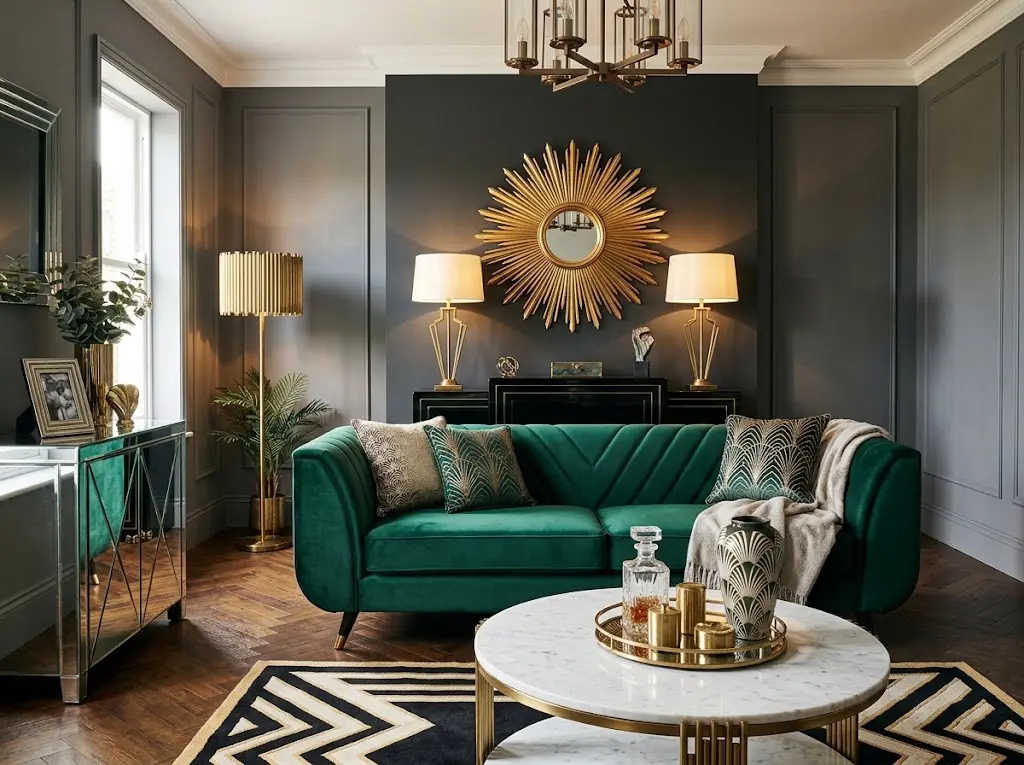
Before buying anything or making any changes, understanding what actually defines the art deco aesthetic makes the difference between a room that feels genuinely considered and one that just has a lot of gold in it.
Geometric pattern and symmetry
Art deco is built on bold, precise geometry — chevrons, sunbursts, stepped forms, fan shapes, and strong vertical lines. Symmetry is central to the style, giving every room a sense of balance and formality that feels intentional rather than accidental.
Rich, luxurious materials
The original art deco movement was defined by its use of expensive materials — marble, lacquered wood, brass, velvet, mirrored glass, and exotic veneers. A modern art deco interior uses the same material palette in more accessible forms without sacrificing the sense of richness those materials bring.
A specific color palette
Art deco color runs from deep, saturated jewel tones — emerald, sapphire, deep burgundy — to rich neutrals like black, cream, and warm gold. The palette is never pastel or muted — even the neutrals carry weight and presence.
Ornamentation with purpose
Unlike maximalism, art deco ornamentation is always structured and deliberate. Every decorative element has a geometric logic behind it, and the overall effect reads as refined rather than cluttered.
The Art Deco Color Palette
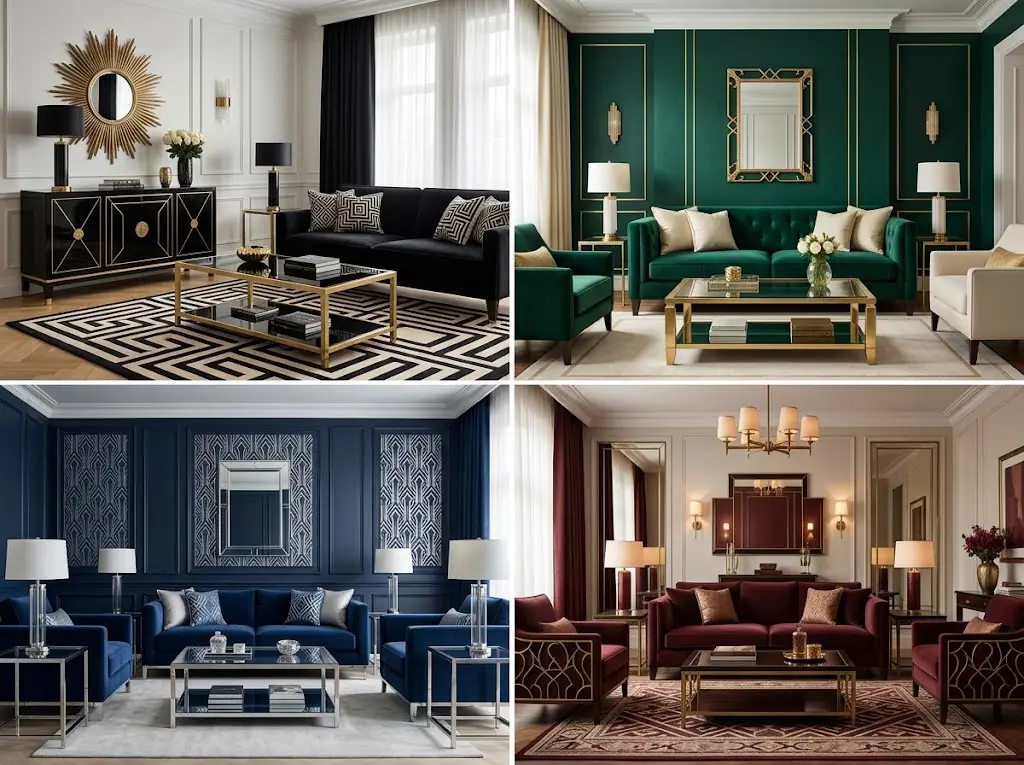
Getting the color palette right is the single most important decision in an art deco interior, since the wrong colors immediately undermine every other element.
- Black and gold is the most iconic art deco combination — used together they immediately read as the style without needing any other elements to confirm it.
- Emerald green against brass or gold is a close second — rich, jewel-toned, and deeply saturated.
- Deep navy or sapphire paired with chrome or silver accents gives a cooler, more contemporary art deco feel.
- Cream and champagne as the base palette with black and gold accents is the most wearable version for a full room.
- Burgundy and gold leans into the warmth and opulence of the original 1930s aesthetic most directly.
- Avoid pale, muted, or pastel tones — they immediately soften the geometry and structure that gives art deco its character.
Art Deco Furniture
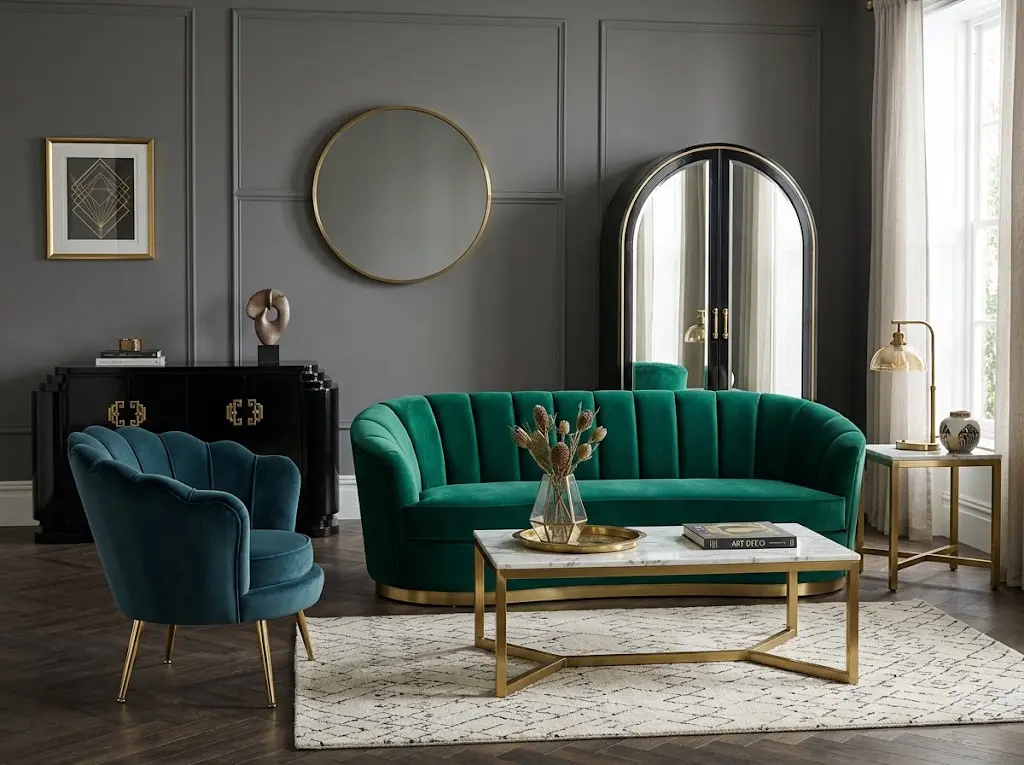
Furniture is where the art deco aesthetic does its heaviest lifting — the shapes, materials, and finishes of the pieces in a room establish the style more definitively than any accessory.
What to look for:
- Curved geometric silhouettes — rounded fronts on cabinets, fan-back chairs, stepped credenzas.
- Lacquered finishes in black, white, or deep jewel tones.
- Brass or gold metal detailing — legs, handles, trim, and inlay work.
- Velvet upholstery in rich, saturated colors — emerald, cobalt, burgundy, or deep teal.
- Mirrored furniture — a mirrored console table or a mirrored bar cabinet is one of the fastest routes to an art deco feel in any room.
What to avoid:
- Overly rustic or reclaimed wood pieces — they work against the polished, precision aesthetic.
- Casual, slubby fabrics like linen or raw cotton on upholstered pieces.
- Furniture with ornate carved detail — art deco ornament is geometric, not floral or traditional.
Art Deco Walls and Floors
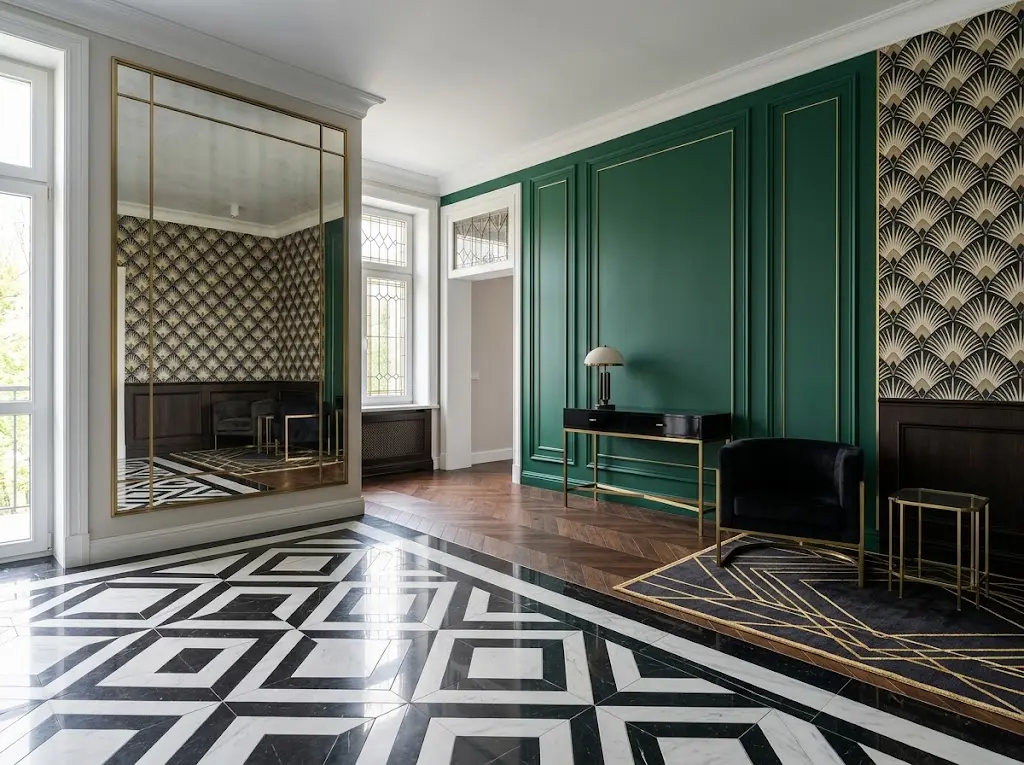
The surfaces of a room set the stage for everything else — in an art deco interior, walls and floors deserve as much consideration as the furniture.
Walls:
- A dark painted feature wall in emerald, navy, or black creates an immediate backdrop for gold and metallic accents to read against.
- Geometric wallpaper in a bold pattern — chevrons, stepped forms, or a fan motif — is one of the most authentic art deco wall treatments available.
- Decorative wall panelling with strong vertical lines echoes the architecture of original art deco buildings.
- Mirrored wall panels on a feature wall amplify the light and luxury that defines the style.
Floors:
- Geometric patterned tiles in black and white are the most classic art deco floor treatment — bold, precise, and immediately recognizable.
- A dark hardwood floor provides a rich base for the jewel-toned rugs and metallic furniture legs that sit on top of it.
- Geometric area rugs in bold, high-contrast patterns carry the art deco motif into rooms where changing the floor itself isn’t possible.
Art Deco Lighting
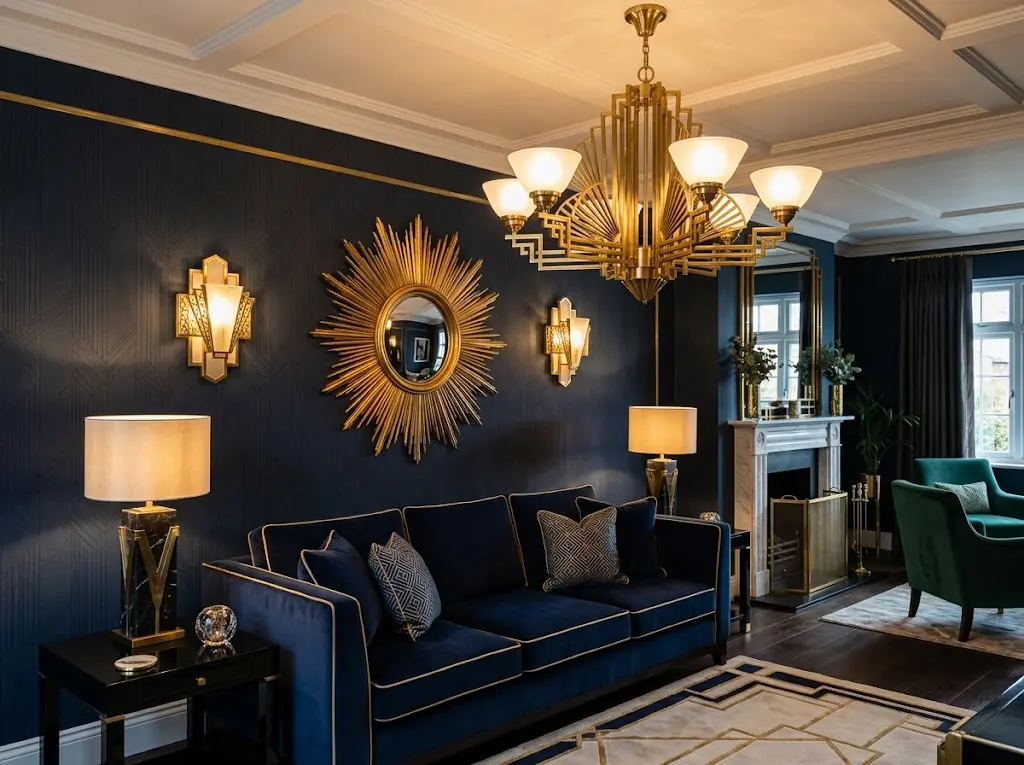
Lighting is one of the most transformative elements in an art deco interior — the right fixtures do as much decorative work as any piece of furniture.
- A sunburst wall mirror or sunburst clock above a mantel or console is one of the most iconic art deco accessories available and one of the easiest to incorporate without committing to a full room redesign.
- Geometric pendant lights in brass or gold with angular or fan-shaped shades hang as sculptural objects as much as light sources.
- Table lamps with angular bases in black lacquer, brass, or marble add the art deco vocabulary to a surface without requiring any installation.
- Sconces on either side of a mirror or bed immediately read as art deco in a way a plain sconce never does.
- Art deco lighting almost always uses warm bulb tones — the cooler, bluer light of daylight bulbs works against the warmth and richness the style requires.
Art Deco Accessories and Decorative Objects
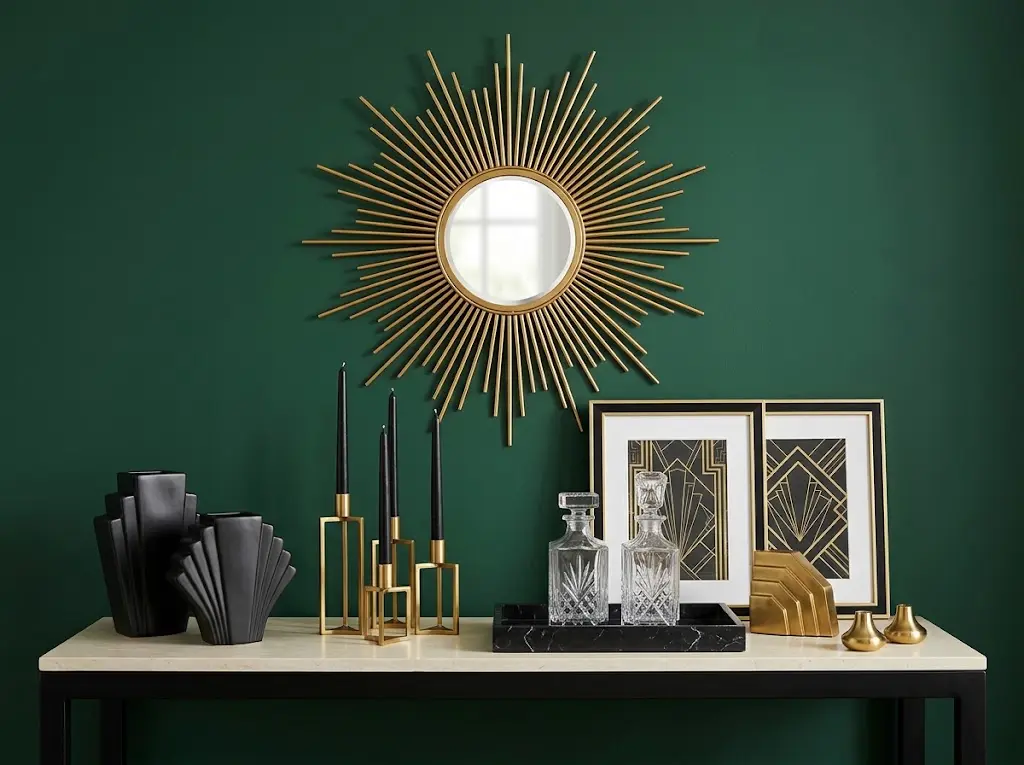
Accessories are where a modern art deco interior finds its flexibility — a room can carry the aesthetic through accessories alone without any furniture changes at all.
- A sunburst mirror in gold or brass is the single most recognizable art deco accessory — hung above a console, a fireplace, or a bed it immediately anchors the room’s aesthetic.
- Geometric vases in black ceramic, gold, or mirrored glass sit on shelves and consoles with the kind of sculptural presence that plain vases rarely achieve.
- A decorative tray in gold or mirrored finish groups smaller accessories together on a coffee table or console.
- Art deco candle holders in brass or black with angular geometric shapes add warmth and period-appropriate decoration to a mantel or table.
- Crystal decanters and glassware displayed in a mirrored bar cabinet or on a console tray are both functional and deeply in keeping with the style’s love of reflective, refractive surfaces.
- Framed geometric prints or original 1930s-inspired poster art in bold black and gold frames contribute to the wall’s story without requiring large-scale art.
Modern Art Deco Interior — How to Apply It Today
A modern art deco aesthetic differs from a period recreation in one important way: restraint. The original art deco interiors of the 1920s and 30s were total environments where every element — the architecture, the furniture, the light fittings, the floor — was designed as part of a unified whole. A contemporary home applies the same visual language selectively, letting the art deco elements stand out against a quieter backdrop rather than competing with each other across every surface.
The most effective approach for a modern home:
- Choose one room or one corner of a room to apply art deco elements fully, rather than scattering individual pieces throughout the whole house.
- Start with the color palette — the right wall color and rug establish the foundation before any accessories go in.
- Invest in one or two strong furniture pieces rather than filling the room with cheaper art deco-adjacent objects.
- Use symmetry deliberately — a pair of matching table lamps, a centered mirror, or matching sconces on either side of a feature wall immediately reads as art deco.
- Keep the surrounding elements simple — art deco pieces need a clean backdrop to read properly, and clutter works directly against the style’s precision.
Room-by-Room Art Deco Ideas
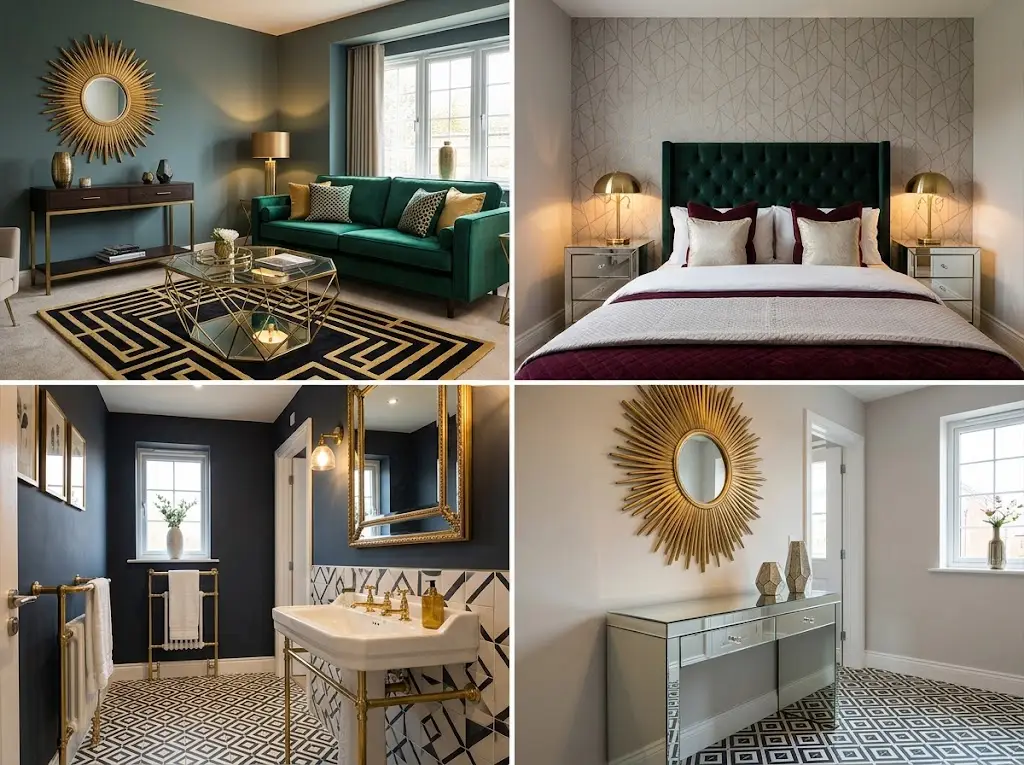
Art Deco doesn’t have to look the same in every room. A few well-chosen pieces can bring that signature mix of bold shapes, rich colors, and polished finishes into different spaces around the home.
Living Room:
A velvet sofa in emerald or cobalt anchors the room with color and luxury, paired with a geometric coffee table in brass and glass and a sunburst mirror above the fireplace or console. A bold geometric area rug in black and gold ties the floor to the furniture above it.
Bedroom:
A tufted velvet headboard in deep jewel tones pairs with brass bedside lamps and a mirrored bedside table. A geometric wallpaper feature wall behind the bed gives the room its art deco character without needing to change the furniture entirely.
Bathroom:
Black and white geometric floor tiles do the majority of the work, paired with brass fixtures — taps, towel rails, and mirror frames — and a dark painted wall in navy or charcoal behind a large mirror.
Entryway:
A mirrored console table with a sunburst mirror above it and a geometric floor tile pattern underfoot creates an art deco arrival moment that sets the tone for the rest of the home.
Art deco interior design rewards commitment — the more consistently its elements are applied within a space, the more powerful the effect. A single sunburst mirror in an otherwise plain room reads as a nice accessory. The same mirror against a dark wall, above a lacquered console, beside a geometric table lamp, starts to feel like a considered aesthetic choice. The style isn’t difficult to get right, but it does require understanding its logic — geometry, luxury, symmetry, shine — and applying that logic deliberately rather than decoratively. Start with one room, commit to the palette, and let the pieces build from there.
FAQ
Is art deco interior design expensive to achieve?
The original art deco style relied on genuinely expensive materials — exotic veneers, handmade tiles, bespoke furniture. A contemporary version can be achieved at almost any budget by focusing on a few key pieces in the right finishes rather than trying to replicate the whole vocabulary at once.
What’s the difference between art deco and art nouveau?
Art nouveau (which preceded art deco) is characterized by flowing, organic, nature-inspired forms — curves, botanicals, and asymmetry. Art deco reacted against this with bold geometry, symmetry, and an industrial-influenced precision. The two are often confused but are visually quite different once the distinction is understood.
How do I mix art deco with a more contemporary aesthetic?
The most successful modern art deco interiors use the style’s material palette — brass, velvet, geometric pattern — within a contemporary framework of clean lines and restrained accessories. The art deco elements provide the personality while the contemporary backdrop stops the room from feeling like a period piece.
What are the most essential art deco accessories to start with?
A sunburst mirror, a geometric vase in black or gold, and one velvet cushion in a jewel tone are three of the most accessible starting points — each immediately reads as art deco without requiring a full room commitment.